SMS vs Email Follow Up: Which Closes More Leads?
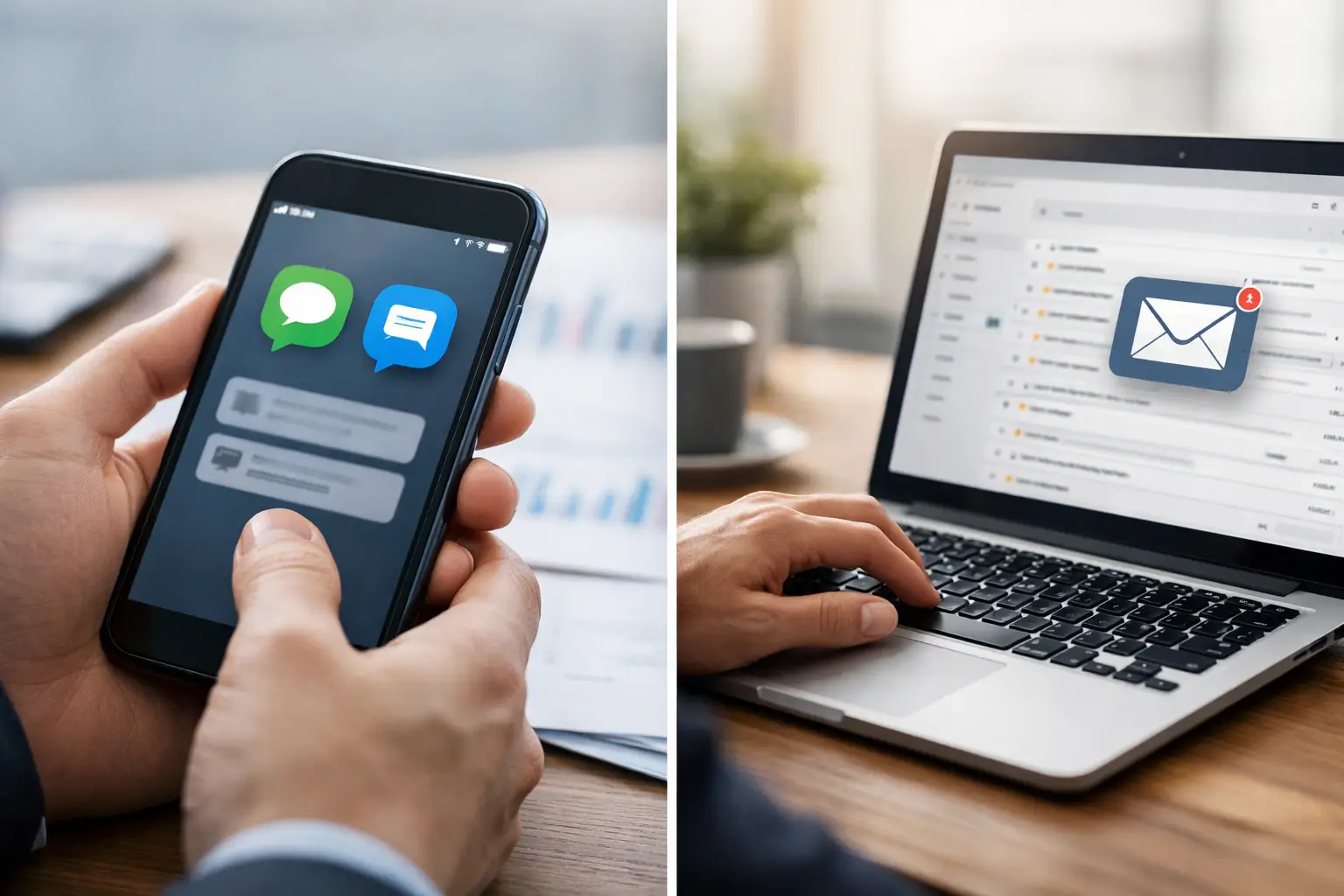
A lead who fills out a form at 7:42 pm is not comparing your marketing channels. They are deciding whether your business is serious about winning their job. The SMS vs email follow up decision matters because the wrong channel, sent at the wrong time, turns a warm opportunity into another ignored record in your CRM.
For appointment-led businesses, follow-up is not admin. It is revenue recovery. SMS creates immediate attention. Email gives you room to explain, educate and prove value. The businesses that close more deals do not treat this as an either-or choice. They build a system that uses each channel for what it does best.
SMS vs Email Follow Up: The Real Difference
SMS is built for urgency. A text lands directly on a prospect's mobile, is usually seen quickly, and makes it easy to ask a simple question: “Would you prefer Tuesday or Wednesday?” That makes it a powerful channel for fresh inbound enquiries, missed calls, appointment reminders and time-sensitive follow-up.
Email is built for depth. It gives you more space to answer objections, show case studies, explain your process, include pricing context and stay visible over a longer buying cycle. A prospect looking for a high-value service may not book after one text, but a useful email sequence can build the confidence needed to take the next step.
The mistake is using either channel as a lazy blast tool. A generic text saying “Just following up” gives the prospect no reason to respond. A long email sent five days after an enquiry arrives after their attention has moved elsewhere. Your message needs a clear job, a relevant trigger and a low-friction next action.
When SMS Wins the Follow-Up Race
SMS is usually the strongest first move when speed matters. If someone has requested a quote, called outside business hours, started a booking form or asked for availability, a quick text can start the conversation while intent is still high.
For example, a clinic enquiry can receive a text within seconds: “Hi Sarah, thanks for reaching out about your appointment. We have openings this week. Is morning or afternoon usually easier for you?” The question is simple, personal and easy to answer. It moves the lead forward without forcing them to read a sales pitch.
SMS also performs well when a lead has gone quiet after showing clear interest. Perhaps they received a proposal, missed a scheduled call or clicked through to book but did not finish. A concise message can bring the conversation back to life: “Hi Dan, are you still looking to get this sorted this month? I can hold a time for you if helpful.”
That does not mean every lead should receive repeated texts. SMS is intimate, and overdoing it feels intrusive fast. Use it for high-intent moments, direct questions and reminders that create genuine value. Keep the message short. Give people a simple way to reply. Respect opt-outs and consent requirements.
SMS is best for action, not explanation
If your objective is to get a reply, confirm a booking, recover a missed call or qualify urgency, SMS has the edge. It reduces delay and removes the need for a prospect to search their inbox later.
But if the customer needs to understand a complex service, compare options or get internal approval, a text alone is rarely enough. That is where email takes over.
When Email Produces Better Leads
Email earns its place when the sale requires more thought than a one-line reply. It is the channel for explaining why your service is worth the investment, what happens next, how you differ from competitors and what results the customer can reasonably expect.
A home services business, for instance, can use email to send a clear quote breakdown, before-and-after examples, service inclusions and answers to common concerns. An agency can follow a discovery call with a tailored recap that frames the cost of doing nothing and maps the next step. A clinic can send preparation details that reduce no-shows and help patients arrive ready to proceed.
Email also gives your team a durable follow-up engine for leads that are not ready today. Many businesses wrongly label these records as dead. They are often simply poorly timed. A thoughtful nurture sequence keeps your business in the frame without demanding an immediate answer every 48 hours.
The strongest emails do not read like newsletters. They are relevant, direct and tied to the lead's original problem. Reference what they asked for. Address the decision they need to make. End with one clear action, whether that is booking a call, replying with a question or choosing a time.
Email is best for trust, proof and timing
Use email when prospects need detail before they commit. It is particularly useful for larger jobs, B2B services, multi-stakeholder decisions and offers where the buyer wants evidence before speaking with sales.
It also gives you a place to send assets that support conversion: a proposal, pricing guide, service overview, testimonial or meeting recap. The purpose is not to bury the prospect in information. It is to remove the specific uncertainty stopping them from buying.
The Best Follow-Up System Uses Both
The highest-performing approach is not SMS versus email. It is a coordinated sequence where each message earns the next one.
Start with speed. When a new enquiry arrives, send an immediate SMS acknowledging it and asking a qualifying or booking-focused question. If the lead does not reply, send an email that provides helpful context and reinforces the next step. If they engage with the email but still do not book, a well-timed text can reopen the conversation.
This combination works because SMS captures attention and email carries the substance. One gets seen. The other gets considered.
A practical flow might begin with a text within the first minute, followed by an email within 10 to 15 minutes. The email confirms the enquiry, outlines what happens next and provides one relevant proof point. If there is no response, follow up over the next several days with different angles: availability, a useful answer to a likely concern, a reminder of the original goal, then a final permission-based check-in.
The sequence should change based on behaviour. A lead who replies by SMS needs a human or AI-assisted conversation, not another automated email pitch. A lead who opens every email but ignores texts may prefer email. A lead who clicks a booking link but abandons it should receive a short prompt that makes completing the booking easier.
Timing Is More Valuable Than More Messages
Most follow-up failures are not caused by weak copy. They are caused by delay. If your team responds hours later, the lead may already be speaking with a competitor who replied first.
Speed-to-lead automation fixes that gap. An always-on response system can acknowledge enquiries, ask initial questions, route urgent conversations and offer booking options while your team is busy, asleep or on-site. That protects the value of leads you have already paid to acquire.
Then comes persistence, handled intelligently. One follow-up is not a system. But ten identical messages are not persistence either. Every touch should add a reason to engage. Change the question, offer a useful detail, refer to their stated need or make the next step easier.
Watch response rates, bookings, show rates, quote acceptance and closed revenue by channel. Open rates alone can be misleading, particularly with email privacy settings. The metric that matters is whether the sequence creates qualified conversations and paid work.
Match the Channel to the Customer and the Sale
There are exceptions. Some corporate buyers may prefer email from the start, particularly where they need a written record or must share details internally. Some consumers will respond faster to a text than they ever will to a formal email. Your industry, ticket size, lead source and customer expectations all shape the right mix.
Ask three questions before designing your workflow. How urgent is the enquiry? How much information does the buyer need before acting? What is the easiest next step for this person right now? The answers will tell you whether to text, email or combine both.
Elite AI Automations builds follow-up systems around that commercial reality: respond immediately, keep every lead moving and put your sales team into conversations worth having. The goal is never automation for its own sake. The goal is more booked appointments and fewer opportunities disappearing into silence.
Your next missed lead is unlikely to announce itself as a problem. It will simply stop replying. Build the follow-up system before that happens, and make every enquiry feel like it reached the fastest business in the market.